Search This Blog

Thursday, 17 May 2012

Spring Fever

Long overdue, here is a summary of CCV Matanzas and APAC volunteer activities during the last two months:

Clinics:
Cardenas April 7, 2012
Since the exportation of anesthetics from Canada, "Flying Clinics" started their new season of sterilization clinics serving Matanzas Province companion animals - both pets and homeless.

Veterinary Clinic in Cardenas
The first great spay/neuter campaign took place on April 7, 2012 in Cardenas. The team had a huge task of preparing the town's veterinary clinic for this occasion. They were expecting someone very special to visit.

The team of doctors and volunteers
The campaign was very well organized and professionally prepared by the Cardenas team. Everything went well and all animals recovered quickly and without any complications.

Dr. Barry MacEachern, our guest of honour, talking to a local TV station - with Ingrid as a translator
Dr. Barry, our special guest was quite impressed with the level of professionalism and knowledge of Cuban veterinarians, and very surprised that a hot weather had little impact on everybody's vigor and enthusiasm. It was during this clinic that Dr. Barry and David met our little Morris whom they later adopted.

Matanzas April 14, 2012
The second clinic was organized in City of Matanzas, province's capital, on April 14, 2012. People were anxious to get in, and stood in line since early morning that Saturday.

Signing up for the surgery
Dr Julio with his assistant
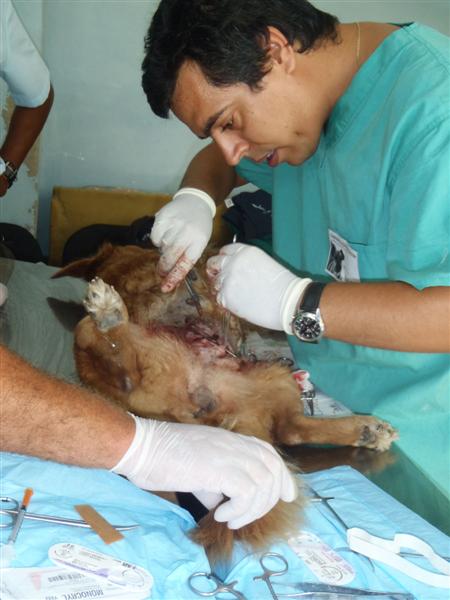
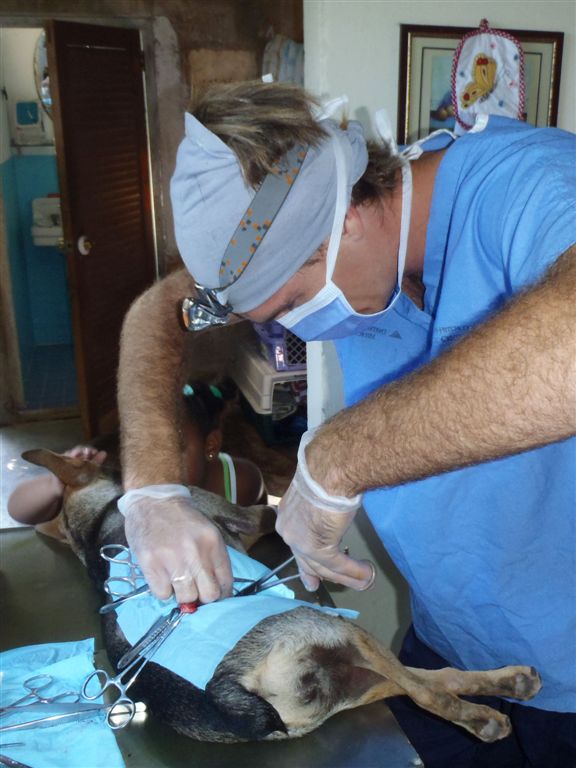
Dr. Hanoi performing surgery


Canadian tourists volunteering at the clinic 
Cardenas May 5, 2012
Dr. Zenkov and Dr. Ponce put together another, smaller campaign in Cardenas. Fifteen animals were successfully sterilized. They had with them our Cuba-Canadian volunteer, Yunetsi Garcia, as well as our young helpers: Ingrid's brother and Dr. Ponce's little daughter. We hope that the children will grow up to be caring, loving people, and who knows - they may choose veterinary science or  medicine as their careers.

Unstoppable Dr. Slavik  

Dr. Ponce's little girl, Deleny,  helping in recovery room

Junior assisting Dr. Ponce with the surgery

Yunetsi practicing her skills
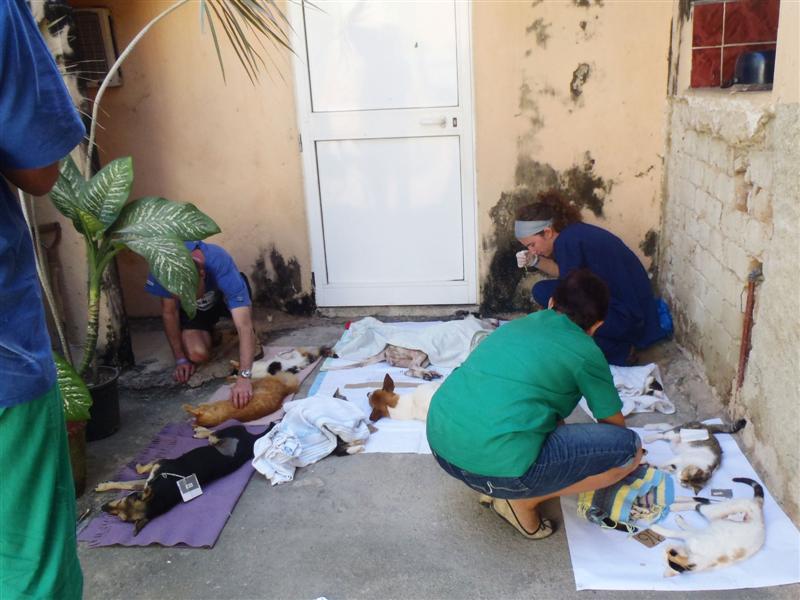
The clinics were hugely successful on many levels. They showed the importance of good preparation and organization - the teams  passed this test with the highest grade. The campaigns are hugely popular amongst locals which proves that Cubans are concerned about proper care of their pets and how spaying/neutering their animals has impact on controlling overpopulation of homeless cats and dogs in their neighbourhoods. A growing number of professional volunteers from Canada brings both nations together in a new way - creating understanding of each other's cultures, and forming long lasting relationships and friendships.

The problem Cuba is facing may not be resolved within one generation, therefore children are involved in the campaigns. For kids these events are the lessons in responsibility, caring, working together, and learning new skills. We are very proud of our young helpers.

Sunday, 11 March 2012

London Ontario Goes Unleashed.


When Jennifer Watts gets excited about something, there is no way of stopping her. We were so lucky that she got excited about APAC-Varadero.

While in Cuba Jennifer met Lynn Wodzak, our dear friend, who introduced Jennifer to our work and efforts. Immediately, the idea of a benefit concert was born. Jennifer comes from a musical background. Her family owns and runs a place called The Music Box where young artists have a chance to present their talents to the public. Jennifer works for a radio station and has a big network of friends. Always on the move, outspoken and energetic, Jennifer did not waste her time. Upon return to Canada she started putting things together.

Before we knew it, a website was created as well as a  Facebook event page were all plans for the big night got posted. Jennifer's enthusiasm and charisma attracted several volunteers for the Unleashed Benefit concert. Sarah Smith, Kill Effect and Sam Taylor agreed to perform on March 2, 2012; several local businesses offered great door prizes, including a set of diamond earrings. 

Unleashed Volunteers 


Jennifer's family donated food and coffee for the event, and drinks were made to warm the audience up.
Lynn set up the display about APAC-Varadero. Everything was ready...
Sarah Smith performing for the Unleashed Benefit
The Music Box was full on the evening of March 2nd. The atmosphere was great - music, games, several door prizes, old and new friends having fun together, and above all - knowing the noble cause of this gathering - created a night to remember. Thanks to the efforts of Jennifer,  Lynn and other volunteers (Courtney Snippe, Tammy, Hilary Hogarth, Amber, Vanessa Ward and Clara Cormier) a substantial  amount of money was raised for our organization. We can now buy more equipment, tools and medications to help Cuban animals.

The Music Box was full


The most special door prize - the canvas bag made by Ingrid out of recycled pieces of fabric.
THANK YOU ALL - those who put the event together and those who came to support it. As Jennifer said: "Let's do it all again soon!"

"It is a faith in something and enthusiasm for something that makes a life worth living"
Oliver W. Holmes


Friday, 9 March 2012

Profile of the Month, March 2012 - 'Ruso'


Dr. Slavik Zenkov
“My name is Viacheslav Zenkov. I was born in Kyrgyzstan in 1986. When I was still little,  my mom got married to a Cuban student and they decided to come live in Cuba. So my mom brought me to Cuba when I was 3 years old, and we have been living in Cuba since.

My mom also gave me a surprise few months after we started our new life. She gave me a pretty sister - Teresa Valentina. Teresa is studying medicine. She is a very good student, in her fourth year now. My mom Liudmila, a forever literature lover, works at the Municipal Library and she is taking courses in Social Studies.

We first lived in a very small town named 
San Luis.  The town was surrounded by farms, and I liked to help with newborn animals. I still remember feeding some chicks, kittens and pups...
No wonder that after primary school I went to study a veterinary technology. After finishing a four-year program, I went to Havana where, after five years, I got a degree in veterinary medicine.
While working at Cardenas Municipal clinic as a sanitary inspector, I had heard about very interesting new group of people working for the animals protection and I decided to join them.  The group had veterinarians and other volunteers, and they organized spay-neuter clinics. I got involved, and helping stray animals became my passion.  My lovely wife, Ingrid, shares my interests, and together we educate pet owners, help stray animals, and rescue several homeless dogs and cats by finding them new homes.

In my free time, or whatever is left of it, I play soccer, go dancing, or take care of my collections of cacti.

My identity has always been my dilemma. I am Russian by blood, birth, name, and looks but also Cuban by language, thoughts, friends, my life, and love for Cuba. All my friends and neighbours call me 'Ruso' ..."

Thursday, 23 February 2012

"If you build it, they will come..."

We have never been as busy as this month. As we grow, more things happen and each event requires our full attention and time. In addition, we are in the middle of the Caribbean 'escape-from-winter' holidays and many travelers e-mail us with questions, offers to help, or requests for help. 
Having said that, here are the highlights of our February activities:

Education:
On February 18, 2012 we had our first Walk-a-Dog event in Cardenas. A group of our supporters and friends gathered on the agreed street in the city, and walked their dogs through the neighbourhoods. Cubans don't walk their dogs on a leash. Most of them let their pets run free, and this is one of the habits contributing to the overpopulation of homeless animals (as most dogs are still not spayed or neutered). This event gave us an opportunity to show people the proper handling of dogs. We were also talking about other benefits of having an animal under friendly control - e.g. bonding with an owner, and  preventing accidents.  It was a successful gathering,  and we intend to repeat it in a near future.

Friends and neighbours getting ready for a walk

  We contacted FAADA's chapter dealing with responsible tourism. FAADA is a non-profit organization dedicated to animal welfare around the world. It is located in Barcelona, Spain. Cuba has close relationships with Spain as the majority of today's Cuban society is of Spanish descent. 
Several resorts in Cuba belong to Spanish corporations. We feel strongly that the tourism industry on the island should be involved in solving the problem of stray animals overpopulation. Many animals hang around hotels in search for food and shelter.
  FAADA Turismo Responsable sent us a package of  brochures presenting FAADA's work and discussing welfare of animals used as tourist attractions around the world, including zoos. We hope these brochures will act as ice-breakers in approaching hotel managers and presenting to them our short and long-term goals. 
Since we got 190 brochures, there will be enough of them to circulate in the neighbourhood as well.


Clinic:
  While Cardenas went for a walk, Matanzas was buzzing with crowds lining up for the massive de-parasitation clinic organized by CCV-Matanzas  and our chief veterinarian, Dr. Hanoi Dominguez, with generous help from Dr, Sergio Chan. Dr. Chan brought enough medications from BAYER to help 420 animals!
  Congratulations to all who organized the clinic and to the volunteer doctors who made it all possible:
Dr. Ledia Lorenzo, Dr. Julio Cesar Perez, Dr. Mabel Del Castillo, Dr. Aimara Hernandez, Dr. Yoenier Perez, Dr. Michel Matoz, Dr. Yudith, Dr. Roimy, Dr. Isidro, Dr. Ever, and Dr. Slavik Zenkov. Thank you to all volunteers who helped to keep things under control during this extremely busy day. The clinic took place in a beautiful location of Matanzas chapter of Asociacion Hermanos Saiz, the organization of young Cuban artists.

'Family'picture
Rescues:
  In spite of efforts to limit the number of international adoptions, we, again, ended up helping several animals go to their new homes in Canada. Our friends visiting Cameleon Villas Jibacoa saved a mother with three pups, and another young female dog, Yolanda, who came with them to Ontario. Charlotte and her friend saved another family of five, and they are going to Montreal on February 24, 2012. Three animals ended up in Nova Scotia, and our special 'machete boy' - Nilo came to Alberta,  looking for a home fitting his personality (dalmatian). 
  We do realize the controversy surrounding this part of our activities, and we always try first to find  homes for our rescues in Cuba. However, this is not always possible. In addition, most dogs or cats have their homes chosen already, and we simply help to meet the requirements for their exportation. The generosity of Air Transat keeps the cost down, and our Canadian supporters supply kennels for the journeys. 

Shipment of kennels from Canada

Ingrid saying good bye to Nilo at the Varadero Airport
"A person often meets his destiny on the road he took to avoid it."
J. de La Fontaine

Thursday, 12 January 2012

New Year, New Challenges

We have finally figured out how to get anesthetics from Canada to Cuba.  The best news is that we have found  doctors who are willing to help us with delivering them to Varadero. We are so happy! And - we want to say Thank you to Terry from the Spanky Project who has patiently guided us through the learning process.

Last year, a group of volunteer veterinarians from the Varadero area performed 1,100 surgeries (at that time anesthetics were received from ANIPLANT while APAC-Varadero supporters brought all other medical and non medical supplies). The year 2012 is our first "independence year" but it also means that we need to cover all the cost of our own surgeries. If we are to have at least 1,000 sterilization surgeries done, we need $5,000.00 CAD to cover the cost of the anesthetics alone. At the present time we have funds for 220 surgeries. We need to collect another $4,000.00 CAD.


We are asking all travelers to Cuba to help us raise money. We hear often, from those who visited Cuba, how stressful it was to see sick and apparently homeless animals wandering around resort areas in search of food, and love. You say that this experience spoiled your holidays. You saved a few of them, and we helped you to bring them to Canada, but we all know this is not enough. The only way to achieve some balance is prevention. Thousands of cats and dogs are born to short and cruel lives of constant hunger and illness. Puppies are often round up and killed with strychnine, kittens are thrown into dumpsters or drowned. We want to change it and we are hoping that you want it too.


We, Canadians are the largest tourist group in Cuba. Over one million Canadians visited Cuba in 2010 spending 748 million dollars on their trips to this beautiful island. If each tourist contributed one dollar to the welfare of the Cuban stray animals, the problem would have been solved already!

We are hoping that you can spare a few dollars to help one Cuban animal to have a better life, and to prevent countless numbers of kittens or puppies to be born to life of suffering and misery.


It has been decided some time ago that one person can change the world. Why don't you try to be that person? 

Thursday, 15 December 2011

Looking Back, Looking Forward

It is this time of year again. The time of looking back at the months gone by,  and making a summary of accomplishments as well as errors, that can be valuable lessons for future plans.

Festival of Trees - Edmonton 2011


Changes
In December 2011, after a few months of meetings and negotiations, Dr. Hanoi Dominguez drafted an agreement between APAC and CCVC ( Consejo Cientifico Veterinarion de Cuba), the Non-Government Organization (NGO). From now on we can import anesthetics and other essential medications from Canada to Cuba. We will function as a project under the patronage of the National Commission for Animal Welafare (COMBAC). Dr. Dominguez is a coordinator of COMBAC for the Province of Matanzas, where most of our work takes place.
This new status allows us to work together with our friends from the Spanky Project, another Canadian organization that helps Cuban animals in the Havana area since 2003.


Clinics

Dr. Slavik Zenkov at the clinic in Cardenas

We are really proud of our achievements. Thanks to a steady supply of anesthetics (mainly from ANIPLANT) our doctors performed close to a thousand  surgeries, most of them in pre-organized clinics across the Province of Matanzas. The clinics prevented several thousands of dogs and cats from being born to life of suffering and homelessness. They also provided our doctors and volunteers with an opportunity to educate Cubans about proper pet care, and to make average persons more sensitive to the situation of stray animals.

Our support network is growing, and people from all over Canada are bringing suitcases of supplies to help with surgeries and other medical needs of animals under our care. We are very grateful for all help we receive, and we appreciate the trust and enthusiasm with which help is offered. We promise not to disappoint you.

Publicity
The very first public appearance of our organization took place at 2011 Pawlooza Festival in London, Ontario. We owe this debut to our most active volunteer, wonderful Lynn Wodzak and her friend Jackie Bowes. They prepared our colorful kiosk and spent the whole day promoting our work in Cuba. Plans are made to do it again next year!

                                         Jackie and Lynn at Pawlooza 2011

Adoptions
Every day, we promise ourselves not to get involved  in adoptions outside Cuba. These are very time consuming and costly. However, we still have to learn how to say 'no'. Increased traffic on our Facebook Page, and Cuba being one of the most popular winter escapes for Canadians, bring to us many individuals asking for help. It is always the same story - of a tourist taking care of an animal that comes to visit at the hotel room. A bond is created, and people find it difficult to leave a dog (or a cat) behind. Even though reluctantly, we do help. Some of the dogs that came from Cuba in 2011 are: Lily, Pepa, Honey, Finn, Poppi, Boots, Nina, Cria, Hoya, Saba, Chico, Che, Rosie, Vera....., and cats: Ernesto, Snickers, Nala and Nina.

Thank you again to CANDi for including us into your agreement with Air Transat, that helps to bring adopted animals to Canada. Thank you Air Transat cargo staff, both Canadian and Cuban for providing excellent service, and delivering all the animals safely into their new homes.


Volunteers
We don't have enough room to list all volunteers who have been supporting us throughout a year. You brought supplies and money, you helped spread good news about us and shared difficult moment with us. We thank you all very much and hope that you will stay with us for the years to come. There is however, one very special volunteer whom we must acknowledge. She helps us on a regular basis with sending kennels, receiving adopted animals and making sure that Canadian tourists don't go to Cuba with empty hands. Thank you Lynn Wodzak for your time and your exceptional friendship.
We also want to thank Ellen Walsh and Susan Meyers for their support (Susan had a bottle drive in Edmonton and collected almost a thousand dollars later spent on medical supplies).


Lynn with Buffy and Lily, a Cuban stray she adopted.


Plans for the Future
We expect to grow and to have more and more impact on welfare of Cuban animals - not only pets and stray dogs and cats, but also working animals, like horses. We plan to spend more time on education and prevention programs addressed to children because it will be up to them to change their country to a place where all animals are cared for and respected.

Again, thank you all who have contributed to our success. We wish you a Very Merry Christmas - full of love for each other and hope for our beautiful planet.


"Education is the most powerful weapon which you can use to change the world." 
N. Mandela

Thursday, 3 November 2011

Autumn Update

Long overdue, here is an update on our latest activities:

Clinics
Two teams were working during the last two months - one headed by Dr. Gladis Ochoa, another one by Dr. Slavik Zenkov. As a result, 80 animals were spayed/neutered (45 dogs and 35 cats). There were also several 'ad hoc' surgeries. Over 800 animals have been sterilized so far in 2011. The surgeries are great opportunity for animal health technicians to learn new skills, and for the public to learn the benefits of pet sterilizations. Everybody is welcome to watch the doctors work (from a safe distance, of course).

Dr. Slavik Zenkov during the surgery

Dr. Gladis Ochoa's team sterilized 34 animals during 2.5 hours clinic on October 15, 2011

Education
The solution to any problem starts from being aware. Learning what to do and how, comes next. Knowing the basics of cats and dogs biology is an important component of understanding the reason of their overpopulation. Proper care for pets is a part of the solution to the stray animals problem. All linked.
We choose to believe that most Cubans are concerned about the well being of their own pets and the street animals but they don't always know what to do about it, where to start. We are trying to empower people by giving them the knowledge they need. In addition to spay/neuter clinics we participate in radio programs and lectures. We also have some printed materials available.
Recently, Dr. Hanoi Dominguez and Dr. Slavik Zenkov were invited to the Agricultural University of Havana (Universidad Agraria de La Habana) to give lectures on animal welfare. Dr. Zenkov prepared a presentation about APAC's work in Matanzas Province. Both lectures had a great feed-back from the audience.

Dr. Hanoi Dominguez lecturing at the university in Havana

Circulating our brochures

Adoptions
As you know, we support local adoptions as one of the ways of reducing the number of street animals. Several animals were placed in their new loving homes recently, including a half-blind puppy in Matanzas. We also help tourists from Canada, and other countries, to adopt an animal that they meet during their stay in Varadero. We do not support the idea of what we call 'bulk adoptions', where the big number of animals is brought to Canada and placed in rescue organizations. Sometimes however, the circumstances leave us with an animal rescued from an exceptionally difficult situation with no immediate adoption available. At the present time, we have two dogs waiting for adoption: Hoya and Nilo. Hoya was brought months ago and is still waiting for the permanent home. Nilo was saved from a horrific injury not long ago, and he has no chance of finding a proper home in Cuba. He is in perfect condition now and ready to start a new life. We are looking into a possibility of bringing both dogs to Canada and asking one of the Canadian rescue organizations for help.

Hoya - mother of six beautiful puppies that were adopted
Nilo - brought back to life after his neck was cut with a machete

Networking
We strongly believe in networking and mutual support of like-minded organizations. More can be achieved through exchange of knowledge and experience than by acting alone. Spanky Project is a Canadian organization established in 2003 in Ontario, and working for the welfare of Cuban animals in the Havana neighbourhoods. Terry Shewchuk, the leader of the Spanky Project organizes several clinics, travelling to Cuba with a team of Canadian veterinary science professionals on a regular basis. Our own Dr. Slavik Zenkov was invited to the Spanky's latest clinic. It was a great event and we plan to join our forces in the future. Thank you Terry!

The Spanky Project team

"Coming together is a beginning, keeping together is progress, working together is success."
H.Ford